
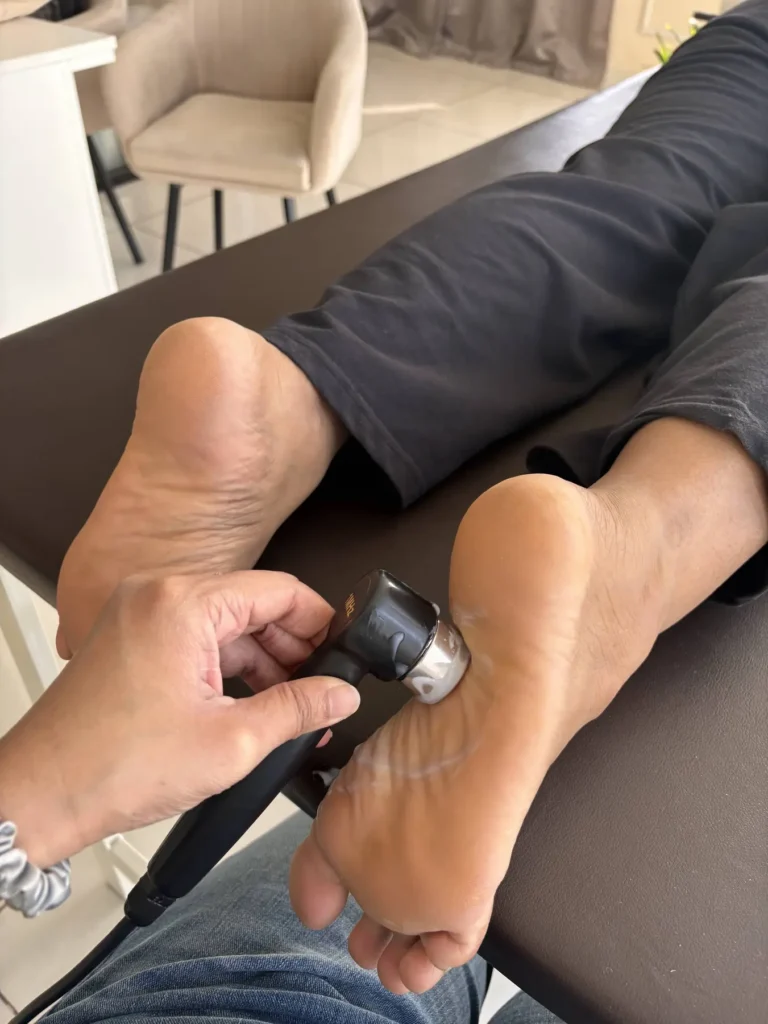
You are lying on the treatment table, and your physiotherapist moves a small handheld device, coated in cold gel, in slow circles over your sore shoulder or knee. You feel a faint warmth, maybe nothing at all, and a few minutes later the device is switched off. This is ultrasound therapy in Indore, one of the most recognizable tools in a physiotherapy clinic, and also one of the most misunderstood.
Patients receiving ultrasound therapy in Indore are rarely told clearly what the machine is doing, why it is used for some conditions and not others, or what the actual research says about how well it works. This guide answers all three questions honestly, including the parts of the evidence that are genuinely mixed, because an informed patient deserves a straight answer rather than a sales pitch, and because understanding the reasoning behind your treatment plan tends to make you a more active, engaged participant in your own recovery.
What Is Ultrasound Therapy?
According to Physiopedia, ultrasound therapy sends deep heating to soft tissues to help reduce pain and promote healing. The device uses high-frequency sound waves, well above the range of human hearing, that pass through the skin into the underlying muscle, tendon, or ligament tissue.
These sound waves cause tiny vibrations within the tissue, and depending on how the machine is set, this can generate a gentle, deep heating effect, or, at lower intensities delivered in pulses, a non-thermal mechanical effect without a significant temperature rise. This is the basic physical principle behind every application of ultrasound therapy in Indore, whether it is being used for a stiff shoulder, a knee with arthritis, or a healing tendon.
How Does Ultrasound Therapy Work?
Two distinct modes are used when delivering ultrasound therapy in Indore, and understanding the difference matters, since confusing the two is a common source of misunderstanding among patients comparing notes about their treatment experiences at different clinics:
- Continuous (thermal) ultrasound, which produces a steady, deep heating effect. This is generally used for chronic conditions where increasing local blood flow and tissue extensibility is the goal, such as persistent muscle tightness or joint stiffness.
- Pulsed (non-thermal) ultrasound, which delivers energy in short bursts, limiting the heating effect while still producing mechanical vibration at the cellular level. This is typically preferred in more acute or inflamed conditions, where added heat is not desirable.
A physiotherapist selects the mode, intensity, and duration based on your specific condition, which is why ultrasound therapy in Indore should always be delivered as part of an individualized assessment rather than a generic, one-size-fits-all setting applied to everyone.
What Does the Research Actually Say?
This is the part most clinics do not explain clearly, and it deserves honesty rather than overstatement. The evidence for therapeutic ultrasound is genuinely mixed, and it varies significantly depending on the specific condition being treated.
Research on chronic non-specific low back pain found that several high-quality studies showed therapeutic ultrasound was more effective than placebo in reducing pain intensity and improving range of motion. Similarly, research reviewing ultrasound for knee osteoarthritis found evidence favoring its use in reducing pain and potentially improving physical function in this population (source).
The honest summary is this: ultrasound therapy in Indore appears to show more consistent benefit for certain specific conditions, including knee osteoarthritis, calcific tendinitis of the shoulder, carpal tunnel syndrome, and some cases of chronic low back pain, while evidence for many general soft tissue injuries remains weaker and more inconsistent. A good physiotherapist will be transparent with you about where your specific condition falls on this spectrum, rather than presenting ultrasound as a universal solution.
Conditions Where Ultrasound Therapy in Indore Is Most Commonly Used
Not every condition responds equally well, which is exactly why an individualized assessment matters more than a standard protocol applied to every patient who walks through the door.
- Knee osteoarthritis, where evidence most consistently supports its use for pain reduction
- Calcific tendinitis of the shoulder, one of the few specific conditions with stronger trial support
- Carpal tunnel syndrome, used as part of a broader conservative treatment approach
- Chronic non-specific low back pain, often combined with exercise rather than used alone
- Soft tissue stiffness and scar tissue, where the deep heating effect may improve tissue extensibility before stretching or manual therapy
- Muscle strains and localized tendinitis, typically as one part of a broader, multi-modal treatment plan
- Plantarfascitis, where US can help in healing overloaded and inflamed fascia.
It is worth noting that ultrasound therapy in Indore, as in most evidence-based practice globally, is rarely used as a standalone treatment. It is almost always combined with exercise, manual therapy, or other active rehabilitation, since passive modalities alone are not considered sufficient for lasting recovery in most musculoskeletal conditions.
What a Session Actually Involves
- A clinical assessment to determine whether ultrasound is an appropriate addition to your treatment plan
- Application of a conductive gel to the treatment area, which helps the sound waves transmit effectively into the tissue
- Slow, continuous movement of the ultrasound head over the treatment area, since holding it still in one spot is avoided to prevent tissue overheating
- A typical treatment duration of five to ten minutes per area, depending on the size of the region being treated
- Combination with other techniques, such as stretching, manual therapy, or strengthening exercises, within the same session
Most patients feel very little during treatment, perhaps a mild, pleasant warmth. Significant pain, burning, or discomfort during a session is not expected and should be reported immediately.
Is Ultrasound Therapy Safe?
Ultrasound therapy in Indore has a good overall safety record when administered correctly by a trained physiotherapist, and serious adverse effects are rare in clinical practice when proper screening and technique are followed. It is generally avoided or used with caution over certain areas and in certain situations, including directly over the eyes, reproductive organs, or a pregnant abdomen, over areas with reduced sensation, over active cancerous tissue, over a pacemaker, and over the growth plates in children. This is why ultrasound therapy in Indore should always be preceded by a proper health screening to rule out these contraindications.
Setting Realistic Expectations
Ultrasound therapy in Indore is best understood as one supportive tool within a broader rehabilitation plan, not a standalone cure. For certain conditions, particularly knee osteoarthritis and specific tendon conditions, it may meaningfully contribute to pain reduction and improved function. For many general soft tissue complaints, its contribution is more modest, and the active components of your treatment, exercise, movement retraining, and manual therapy, are likely doing more of the actual therapeutic work.
A transparent physiotherapist will explain this distinction rather than implying that the machine alone will resolve your condition, and will adjust your treatment plan based on how you actually respond, rather than continuing a modality indefinitely without reassessing its benefit.
Questions Worth Asking Your Physiotherapist
- Why is ultrasound therapy specifically being recommended for my condition?
- What other active treatment, such as exercise or manual therapy, will be combined with it?
- How will we know if it is actually helping, and when will we reassess?
- Are there any reasons I should not receive ultrasound therapy, based on my health history?
A confident physiotherapist offering ultrasound therapy in Indore should welcome these questions rather than treating them as a challenge to their clinical judgment.
If you are exploring broader treatment options, you can also read more about our bone and joint physiotherapy programmes or learn about our sports injury rehabilitation services for a complete view of how different treatment tools fit together.
How Ultrasound Fits Into Your Overall Treatment Plan
It is worth understanding where this single modality sits within a complete physiotherapy visit. A typical session combining ultrasound with other treatment will usually begin with a brief reassessment of your symptoms, followed by the ultrasound application itself, and then move into the more active components of your plan, such as manual therapy, targeted exercises, or functional movement retraining. The ultrasound portion is generally the shortest part of the overall session, which reflects its role as a supportive adjunct rather than the primary driver of your recovery.
Patients sometimes assume that more sessions, or a longer duration of ultrasound at each visit, will produce proportionally faster results. This is not well supported by the evidence. Beyond a certain point, simply extending ultrasound exposure does not appear to meaningfully improve outcomes, and the focus is better placed on progressing the active exercise components of your rehabilitation instead.
A Realistic Outlook
Ultrasound therapy in Indore is neither a miracle treatment nor a useless formality, and the honest answer sits firmly between those two extremes. The evidence genuinely supports its use for specific conditions, while remaining weaker for others, and the most important factor in whether it helps you is not the machine itself, but the clinical judgment of the physiotherapist deciding when, how, and alongside what other treatment to use it.
No single modality, however impressive it looks on a treatment table, replaces the active work of exercise and movement retraining. Ultrasound is a supporting tool, not the main event.
Frequently Asked Questions About Ultrasound Therapy Physiotherapy in Indore
1. Does ultrasound therapy actually work?
The evidence varies by condition. It shows more consistent benefit for knee osteoarthritis, calcific tendinitis, and some cases of chronic low back pain, while evidence for many general soft tissue injuries is more mixed and nuanced.
2. Does ultrasound therapy hurt?
No, most patients feel only a mild, pleasant warmth or nothing at all. Significant discomfort during treatment is not expected and should be reported to your physiotherapist.
3. How many sessions of ultrasound therapy are usually needed?
This depends on the condition and how you respond, but it is typically used over several sessions as part of a broader treatment plan, with reassessment along the way.
4. Can ultrasound therapy be used on its own without other treatment?
It is rarely recommended as a standalone treatment. It is almost always combined with exercise, manual therapy, or other active rehabilitation for the best outcome.
5. Is ultrasound therapy in Indore the same as a diagnostic ultrasound scan?
No. Diagnostic ultrasound creates images to look inside the body, while therapeutic ultrasound uses sound waves to produce a treatment effect in soft tissue. They use similar technology for very different purposes.
6. Who should avoid ultrasound therapy?
It is generally avoided over the eyes, reproductive organs, a pregnant abdomen, areas with reduced sensation, active cancerous tissue, pacemakers, and growth plates in children.
7. Why does my physiotherapist keep moving the device instead of holding it still?
Holding the ultrasound head still in one spot can cause localized overheating of the tissue, so continuous, slow movement is used to distribute the energy evenly and safely.
8. Is pulsed ultrasound better than continuous ultrasound?
Neither is universally better. The choice depends on your specific condition, with pulsed ultrasound often preferred for more acute or inflamed presentations and continuous ultrasound for chronic stiffness.
9. Will ultrasound therapy alone fix my chronic pain?
It is unlikely to resolve chronic pain on its own. It works best as one component of a broader rehabilitation plan that includes exercise and addressing the underlying contributing factors.
10. How do I know if ultrasound therapy is genuinely helping me?
A good physiotherapist will track your pain, function, and range of motion over time and adjust or discontinue the modality if it is not contributing meaningfully to your progress.
Medical Disclaimer: This article is intended for general informational purposes only and does not replace professional medical advice, diagnosis, or treatment. Please consult a qualified physiotherapist to determine whether ultrasound therapy is appropriate for your specific condition.