If you have recently suffered a knee injury on the field or during a workout, hearing the words “ACL tear” can be devastating. Your first thought is likely a vision of surgery, months on crutches, and a long scar. However, a question many of my patients in Nipania ask during their first consultation is: “Is ACL treatment without surgery actually possible?” The answer, backed by modern sports medicine, is a resounding yes, but only if you meet very specific clinical criteria.
For residents of Apollo DB City or Ocean Park, the decision to opt for conservative management over reconstruction is a biological and lifestyle-based choice. Not every torn ligament requires a surgical fix. Through specialized ACL treatment without surgery, many individuals return to their daily routines and even low-impact sports. This guide explores the “Copers vs. Non-Copers” theory and the phase-wise rehabilitation needed to stabilize a knee using only the power of your muscles and nervous system.
The Science of “The Coper”: Why Some Knees Don’t Need Surgery
In the medical community, we categorize patients into two groups: Copers and Non-Copers. A “Coper” is an individual whose neuromuscular system is so efficient that it can compensate for the missing ligament. Their brain quickly retrains the hamstrings and quadriceps to prevent the “giving way” sensation that usually follows a tear. This is the primary target group for ACL treatment without surgery.
Research published on PubMed suggests that with the right rehabilitation, the body can adapt to an ACL-deficient state. The goal of our ACL treatment without surgery program is to turn every suitable candidate into a “Coper.” This involves intensive training to restore the mechanoreceptors in your joint—the tiny sensors that tell your brain where your knee is in space. If you are a resident of Nipania looking for a non-invasive path, understanding this biological adaptation is the first step.
Are You a Candidate for Non-Surgical Recovery?
While we would love to offer ACL treatment without surgery to everyone, it is not always the safest path. We typically recommend conservative management for the following individuals:
- Grade 1 or Grade 2 Tears: Where the ligament is stretched or only partially torn, leaving some structural integrity intact.
- Sedentary or Low-Impact Lifestyles: If your daily routine involves office work and light walking around Nipania rather than pivoting sports like football or basketball.
- Skeletally Mature Adults: Older individuals who may have pre-existing degenerative changes where surgery might not offer additional benefits.
- The “Stable” Knee: Patients who do not experience “episodes of giving way” during their daily functional tasks.
If you fall into these categories, ACL treatment without surgery can be highly successful. However, if you are a professional athlete needing to return to high-level pivoting, we often integrate this conservative phase as “pre-habilitation” before a planned surgery. You can learn more about the surgical recovery path on our sports injury physiotherapy in Indore page.
The Phase-Wise Protocol for Conservative Management
Choosing ACL treatment without surgery does not mean doing nothing. In fact, it often requires more dedication to physiotherapy than the surgical route. We follow a strict phase-wise protocol to ensure the joint remains protected.
Phase 1: Acute Protection and Swelling Control
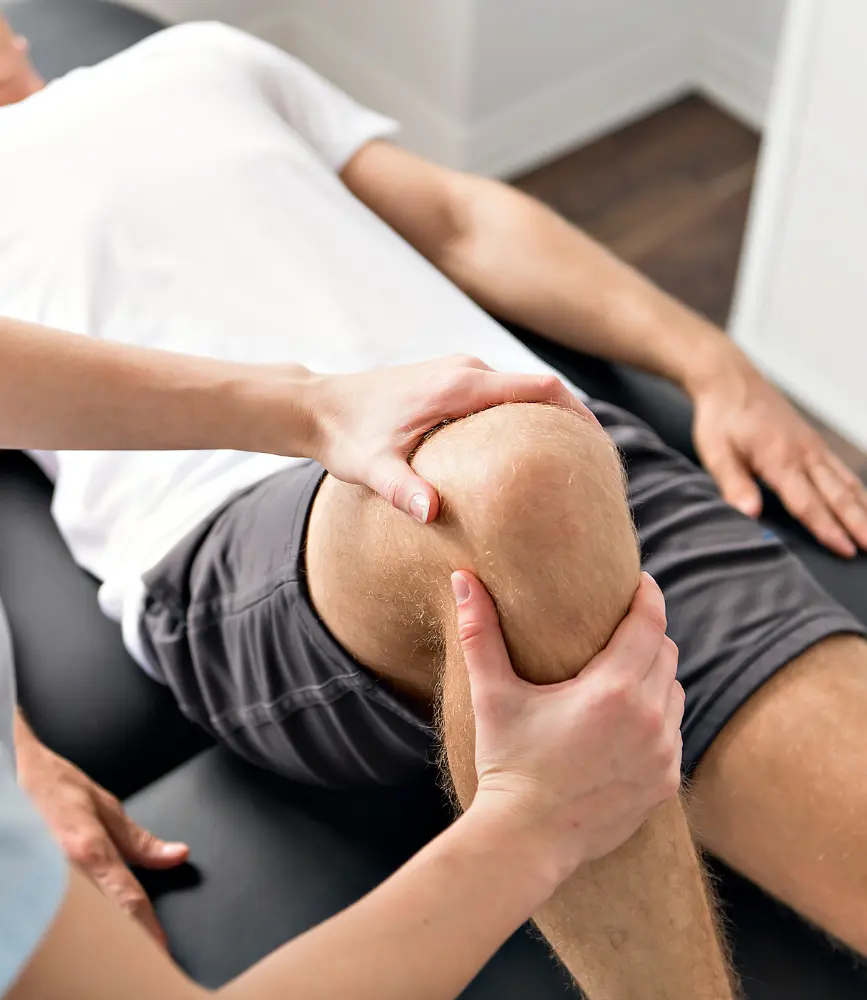
In the first two weeks, the focus is on reducing the pain and swelling in the knee. We use manual therapy and specialized modalities to reduce inflammation. For patients, early range of motion is vital to prevent stiffness. We use specific bracing techniques to provide external stability while the internal swelling subsides.
Phase 2: Progressive Muscle Loading
Once the pain is managed, ACL treatment without surgery moves into heavy muscle activation. Since the ligament is no longer the primary stabilizer, the hamstrings must take over the job of preventing the tibia from sliding forward. We focus on “eccentric” hamstring strengthening, which is the most effective way to protect an ACL-deficient knee.
Phase 3: Neuromuscular and Proprioceptive Training
This is where the real “magic” happens. We use balance boards, foam pads, and perturbation drills to challenge your knee’s stability. For residents near Nipania Main Road, this phase involves retraining the brain to react to sudden changes in surface or direction. This is the core of successful ACL treatment without surgery.
The Role of Knee Bracing in Non-Surgical Care
For those undergoing ACL treatment without surgery, a high-quality functional brace can be a game-changer. These are not the simple neoprene sleeves found at a local chemist. A functional ACL brace uses a 4-point leverage system to mechanically limit the forward movement of the shin bone. This provides the patient with the confidence to move throughout Ocean Park or BCM Paradise without the fear of the knee “buckling.”
According to guidelines from the Cleveland Clinic, bracing can be an effective adjunct to physical therapy in conservative management. It acts as a safety net while your muscles are still gaining the strength needed to support the joint independently. We provide custom brace selection as part of our ACL treatment without surgery program in Indore.
Potential Risks of Avoiding Surgery
As a medical professional, I must be honest about the risks. While ACL treatment without surgery is effective for many, there is an increased risk of meniscus tears over time if the knee remains unstable. Every time the knee “gives way,” the shock-absorbing cartilage (meniscus) takes the hit. If you find that despite high-quality ACL treatment without surgery your knee remains unstable, a delayed reconstruction may be the safer long-term option to prevent early arthritis.
We monitor our patients in Nipania very closely for these signs. If you are experiencing locking or catching in the joint, please refer to our knee pain physiotherapy in Indore section for more on how we diagnose secondary injuries.
Why Our Nipania Clinic is the Best Choice for Your Recovery
Success in ACL treatment without surgery depends entirely on the expertise of your therapist. It requires a deep understanding of biomechanics and the ability to push the patient safely. Our clinic, located at Divyansh Square 2 in Nipania, offers a high-performance environment tailored for these complex recoveries. Being a University Gold Medalist, I ensure that every exercise in your protocol is based on the latest international research.
We provide a convenient location for residents of Grand Exotica, Shivalika, and Skye Luxuria. Instead of traveling across Indore, you can access elite-level sports physiotherapy right in your neighborhood. Our goal is to provide ACL treatment without surgery that is so effective, you forget your ligament was ever injured.
“Surgery is a tool, not a requirement. For the right patient, a well-structured rehabilitation program is the most powerful medicine we have.” – Dr. Manisha Mishra (MPT).
Conclusion: Empowering Your Recovery Journey
The path of ACL treatment without surgery is one of empowerment. It puts the control of your recovery back into your hands—literally. By building a “muscular brace” around your knee and retraining your nervous system, you can often return to the things you love without the need for an operation. If you are in Indore and wondering if you can avoid the OT, come in for a biomechanical assessment. Let us help you determine if you are a “Coper” and design a roadmap for your non-surgical success.
Frequently Asked Questions
1. Can a completely torn ACL heal without surgery?
A completely torn ACL has a very limited ability to “re-attach.” Unless you fulfill the criteria mentioned above, surgery might provide a more suitable outcome to young, active patients.
2. How long does non-surgical ACL rehab take?
A typical program for ACL treatment without surgery lasts between 3 to 6 months, depending on your initial strength and your functional goals.
3. Will I get arthritis earlier if I don’t have surgery?
The risk of arthritis is linked to joint instability, not just the absence of the ligament. If ACL treatment without surgery keeps your knee stable, the risk is significantly lower.
4. Can I play football again without an ACL?
It is possible but very difficult. Pivoting sports put the highest demand on the ACL. Most athletes opting for ACL treatment without surgery eventually transition to low-impact sports like cycling, swimming, or running.
5. What is the success rate of non-surgical treatment?
For correctly selected patients (the “Copers”), the success rate of ACL treatment without surgery is quite high, with many patients returning to full activity levels.
6. I live in Skye Luxuria; how do I start?
You can book a consultation at our Nipania clinic. We will perform a physical exam and review your MRI to see if you are a candidate for conservative care.
7. Do I need to wear a brace forever?
No. In ACL rehabilitation, the brace is often used during the initial strengthening phase or during high-risk activities like hiking or traveling.
8. Is physiotherapy painful?
While some discomfort is expected during muscle building, ACL treatment without surgery should never be agonizing. We adjust the load to your tolerance.
9. Can I walk my dog in Apollo DB City while recovering?
Yes, but we recommend using a brace and staying on flat surfaces during the early weeks of your ACL treatment without surgery to avoid sudden slips.
10. What if my knee still feels loose after 3 months of rehab?
If stability isn’t achieved after dedicated ACL treatment without surgery, we will discuss the possibility of surgical reconstruction with your orthopedic surgeon.
Medical Disclaimer: This article is for educational purposes only. ACL injuries are serious medical conditions. You must consult a qualified orthopedic surgeon and a physiotherapist to determine the best course of action for your specific injury. Never attempt high-impact activities without medical clearance. If your knee locks or gives way repeatedly, seek immediate medical attention.