
You take a step down the stairs, and there it is again. A sharp, aching pain right under or around your kneecap. It feels like your knee is unstable, grinding, or simply refusing to support your weight properly. If you live in Indore and find yourself limiting your morning walks around Nipania or skipping your favorite fitness routines because of this constant discomfort, you are likely searching for effective VMO Exercises for Knee Pain to restore your mobility.
Many people assume that knee pain is just a natural sign of aging or an inevitable consequence of working out. However, the root cause is frequently a subtle muscle imbalance right above your joint. Specifically, it often involves a weakness in a specialized part of your quadriceps muscle known as the Vastus Medialis Oblique, or VMO. When this muscle loses its strength, your entire knee mechanics break down. Learning the proper execution of VMO Exercises for Knee Pain can prevent these tracking issues from worsening over time.
The good news is that targeted physical therapy can correct this issue without major intervention. This guide will walk you through exactly what the VMO muscle does, why it causes pain when neglected, and how executing specific VMO Exercises for Knee Pain can rebuild your joint protection and reclaim your fluid movement.
Understanding the VMO Muscle and Why Your Joint Hurts
To understand why your knee hurts, it helps to look at how your kneecap moves. Your kneecap, or patella, sits in a shallow groove at the end of your thigh bone. Every time you bend or straighten your leg, the patella should glide smoothly up and down within this groove like a train on a track. When tracking fails, incorporating routine VMO Exercises for Knee Pain becomes essential to stabilize the bone.
Your quadriceps muscle group is responsible for controlling this movement. The VMO is the teardrop-shaped muscle located on the inner side of your thigh, just above the kneecap. Its primary, critical job is to pull the kneecap inward during movement, keeping it perfectly centered. Some patients often require customized VMO Exercises for Knee Pain to ensure this tracking remains perfectly straight during high-impact activities.
If your VMO becomes weak or fires too slowly, the larger muscles on the outside of your thigh take over. They pull the kneecap outward, causing it to rub against the bone. This improper tracking irritates the cartilage beneath the surface, leading to a condition commonly referred to as patellofemoral pain syndrome or runner’s knee. Research published by PubMed confirms that correcting patellar tracking through targeted quadriceps strengthening is key to long-term knee joint stability. Dedicated clinical programs focusing on VMO Exercises for Knee Pain are highly effective at reversing this alignment fault.
Recognizing the Signs of VMO Weakness
How do you know if a weak VMO is the main culprit behind your knee discomfort? Muscle imbalances show up during specific daily movements. You might notice definite warning signs that point toward a clear need for VMO Exercises for Knee Pain:
- Pain when going downhill or down stairs: This action places a high eccentric load on the quadriceps, forcing a weak VMO to fail at stabilizing the kneecap.
- A grinding or popping sensation: Known medically as crepitus, this occurs when the kneecap rubs unevenly against the thigh bone groove, a clear indicator to start VMO Exercises for Knee Pain.
- Pain after prolonged sitting: Often called the theater sign, sitting with bent knees for long periods pinches the irritated structures under the misplaced kneecap.
- Visible muscle wasting: If you compare both thighs in the mirror, you might notice that the inner teardrop muscle on your painful leg looks smaller or softer than the one on your healthy leg, proving you need targeted VMO Exercises for Knee Pain to rebuild the lost volume.
Getting Started with Safe VMO Exercises for Knee Pain at Home
Before you begin any exercise regimen, it is important to focus on precision rather than force. The VMO is a stabilizer muscle, which means it responds best to controlled movements and mindful muscle contractions. Practicing safe VMO Exercises for Knee Pain ensures you rebuild control without introducing unnecessary strain into the joint capsule.
1. The Quad Set (Isometric Quadriceps Contraction)
This is the starting point for knee rehabilitation. It helps your brain re-establish a connection with the inner thigh muscle without putting stress on the knee joint. It is widely considered one of the safest initial VMO Exercises for Knee Pain. The exercise involves knee tightening by focusing on the inner thigh region while pressing the knee down.
2. Straight Leg Raise with External Rotation
By slightly turning your foot outward during a straight leg raise, you change the angle of pull and put more demand directly onto the VMO. This modification makes it one of the top recommended VMO Exercises for Knee Pain.
3. Short Arc Quads
This movement targets the final 30 degrees of knee extension, which is the specific range where the VMO muscle is most active in centering the kneecap. Adding short arc extensions to your routine optimizes your selection of VMO Exercises for Knee Pain.
Advanced Progressions for Long-Term Joint Stability
Once you can perform the basic knee exercises without experiencing discomfort, you need to transition to functional, weight-bearing movements. These advanced variations teach your VMO to stabilize your knee while you are standing, walking, and balancing. Progressing to closed-kinetic chain VMO Exercises for Knee Pain mirrors real-world physical demands much better than static floor training.
4. The Terminal Knee Extension (TKE)
This exercise utilizes a resistance band to provide a smooth, consistent pull that forces the VMO to work hard against gravity during the final phase of standing straight. It stands out among functional VMO Exercises for Knee Pain because it mimics walking mechanics.
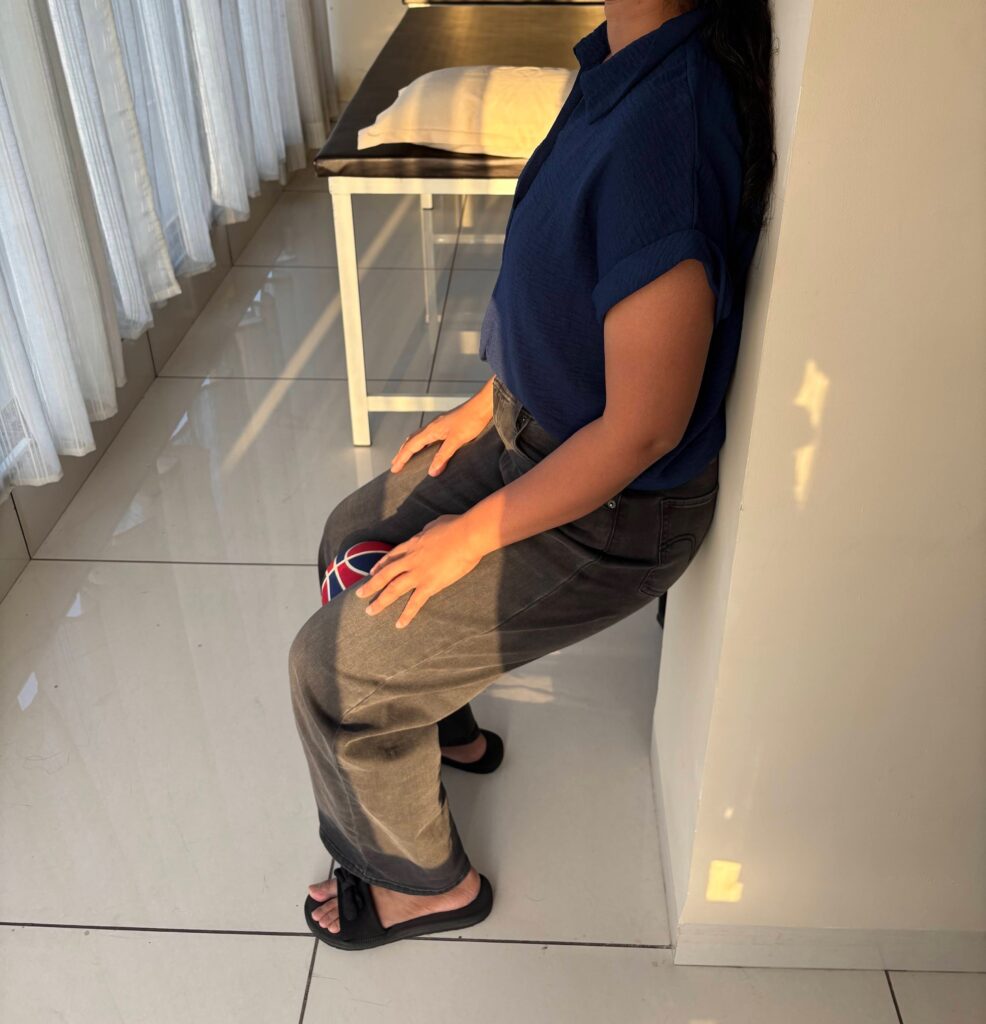
5. Wall Slides with a Ball Squeeze
Squeezing an object between your knees activates your adductor muscles. Because the VMO shares an anatomical pathway with these muscles, squeezing helps trigger a stronger VMO contraction. Combining these actions gives you one of the most comprehensive VMO Exercises for Knee Pain available.
Common Mistakes to Avoid During Your Rehabilitation
When dealing with joint issues, how you perform an exercise matters much more than how many repetitions you complete. Avoid these common pitfalls to keep your VMO Exercises for Knee Pain safe and highly effective:
- Rushing through the movements: Moving too fast allows momentum to take over, which bypasses the VMO entirely and forces larger muscles to do all the work.
- Pushing through sharp pain: A mild muscle burn is perfectly fine, but sharp, pinching pain inside or behind the kneecap means you are aggravating the joint cartilage. Stop your VMO Exercises for Knee Pain immediately if this occurs.
- Allowing your knee to cave inward: During standing exercises like wall slides, keep your knee aligned directly over your second toe. Letting your knee collapse inward places severe strain on your ligaments.
- Neglecting your hip muscles: The hips control the position of your thigh bone. If your hips are weak, your knee will twist out of alignment no matter how many VMO Exercises for Knee Pain you complete. Consider visiting our knee pain physiotherapy page to know details about mechanics of knee pain and how physiotherapy rehab can help improve your daily functioning.
The Role of Professional Guidance for Knee Pain in Indore
While home exercises provide an excellent foundation, chronic knee issues often require a personalized approach. Every individual has unique biomechanics, and what works for a simple muscle strain might not suffice for a structural alignment issue or a ligament injury. If you have been struggling to find relief on your own, utilizing professional guidance to refine your VMO Exercises for Knee Pain is the safest next step.
For residents living in the Nipania or broader Indore area, seeking specialized care can save you months of frustration. A skilled therapist can perform specific clinical tests to measure your exact muscle firing times, check your foot arch alignment, and ensure your hips are supporting your knees correctly. If you would like to explore tailored treatment plans for your musculoskeletal issues, you can visit Dr Manisha Physiotherapy Clinic.
Modern physical therapy clinics offer a range of advanced modalities to complement your exercise routine. For example, manual therapy can loosen tight structures on the outside of your thigh, making it much easier for your VMO to hold your kneecap in place. For deeper insight into how structured rehabilitation programs use specific VMO Exercises for Knee Pain for long-term recovery, you can review guidelines provided by organizations like the NHS. Clinical assessment ensures you do not waste time on incorrect movements.
Timeline for Recovery: What to Expect
Realigning a joint takes time, patience, and consistency. Muscle tissue requires regular, targeted stress to grow stronger and change its firing patterns. When embarking on a journey filled with daily VMO Exercises for Knee Pain, here is a realistic timeline of what most patients experience during a structured program:
- Weeks 1 to 2: You will likely notice an improvement in your mind-muscle connection. Your knee might begin to feel a bit more stable during basic daily activities, although your baseline pain levels may only change slightly as you adapt to initial VMO Exercises for Knee Pain.
- Weeks 3 to 6: As the VMO gains strength and begins to alter patellar tracking, you should notice a significant decrease in the grinding sensation and less discomfort when climbing down stairs.
- Weeks 6 and beyond: With continued functional training, the joint tracking becomes more automatic. You can safely advance your VMO Exercises for Knee Pain to include sport-specific drills, allowing a return to higher-impact activities with minimal to no discomfort.
Consistency beats intensity when it comes to joint rehabilitation. Doing five minutes of focused, correct VMO contractions every single day is infinitely more effective than doing an exhausting one-hour workout once a week.
Frequently Asked Questions Regarding VMO Strengthening
How long does it take to strengthen the VMO muscle?
It typically takes about 4 to 6 weeks of consistent daily exercise to notice measurable changes in VMO muscle strength and a reduction in knee pain. Noticeable improvements in muscle activation and joint stability often occur within the first two weeks of performing localized movements.
Can walking help strengthen a weak VMO?
Regular walking is excellent for overall joint health, but it does not specifically isolate or strengthen a weak VMO. If your kneecap is tracking incorrectly, walking long distances without doing specific VMO Exercises for Knee Pain can sometimes increase joint irritation due to repetitive friction.
Why does my knee pop when I perform these exercises?
Mild popping or clicking without pain is usually just fluid shifting or a minor tissue adjustment within the joint. However, if the popping is accompanied by a sharp pain or swelling, it indicates that your kneecap is rubbing abnormally, meaning your VMO Exercises for Knee Pain need clinical modification.
Can I use a knee brace while doing VMO exercises?
It is generally best to perform your physical therapy exercises without a brace so that your stabilizing muscles are forced to do the work. You can wear a supportive patellar tracking brace during the day for walking or working if it helps reduce your immediate pain during normal activity.
Is cycling good for VMO development?
Yes, cycling with proper form can be very beneficial because the final push-down phase of the pedal stroke engages your quadriceps. Ensure your bike seat is adjusted to the correct height so your knees do not bend too deeply at the top of the stroke, which keeps it well-aligned with your VMO Exercises for Knee Pain goals.
Should I use ice or heat after completing my knee exercises?
If your knee feels warm, swollen, or achy after your exercise session, apply an ice pack wrapped in a cloth for 15 minutes to reduce inflammation. If your joint simply feels stiff and tight before starting your VMO Exercises for Knee Pain, a heating pad can help relax the tissues.
Are squats safe to perform if I have VMO weakness?
Squats can be safe and highly effective if you limit your depth. Avoid deep squats where your hips drop below your knees, as this places massive pressure on the patellofemoral joint. Stick to shallow wall slides or partial squats initially to protect the cartilage.
Can flat feet cause my VMO to become weak?
Yes, flat feet cause your ankles to roll inward, which forces your shin and thigh bones to twist inward as well. This structural shift alters the pulling angle of your quadriceps, making it very difficult for the VMO to function correctly without focused corrective training.
How often should I perform these VMO exercises every week?
Low-intensity activation exercises like quad sets and straight leg raises can be performed daily. More intense weight-bearing variations, such as wall slides and terminal knee extensions, should be done 3 to 4 times a week to allow for proper muscle recovery and tissue building.
When should I stop exercising and see a physiotherapist in Indore?
You should consult a professional immediately if you experience sudden joint swelling, severe pain that lasts long after your session, an inability to bear weight on your leg, or if your symptoms fail to improve after a month of consistent home exercise routines.
Medical Disclaimer
The information provided in this article is intended strictly for educational and informational purposes. It should not be used as a substitute for professional medical advice, diagnosis, or treatment. Always consult with a qualified healthcare professional or physiotherapist before starting any new exercise program, especially if you are experiencing severe or chronic knee pain.