
You might find yourself constantly worrying about your ankle giving out while jogging? If you are living with the constant fear that your foot will buckle under your own weight, you are not dealing with a string of bad luck. You are experiencing a structural and neurological failure known as chronic ankle instability. To fix this permanently, starting a systematic program for Ankle Instability Rehab in Indore is the only reliable way to rebuild your joint armor.
Most people treat an ankle sprain as a temporary inconvenience. They rest for a few days, wait for the swelling to subside, and return to their routine once the acute pain fades. This incomplete approach is exactly why an initial ligament twist transforms into a permanent problem. When an injury heals with loose scar tissue and poor nerve coordination, the joint loses its structural protective guard. To break this cycle and restore your confidence with every step, undergoing a structured program for Ankle Instability Rehab in Indore is the absolute cornerstone of long term mobility.
The Hidden Mechanics Behind an Ankle That Keeps Giving Out
To understand why your joint feels loose, you have to look beneath the skin at the lateral ankle ligaments. The outside of your ankle is held together primarily by three bands of tissue: the anterior talofibular ligament (ATFL), the calcaneofibular ligament (CFL), and the posterior talofibular ligament (PTFL). When you suffer a typical inversion injury, where the foot rolls inward, the ATFL is the very first line of defense to stretch or tear.
When these ligaments do not heal at their proper resting length, they become elongated and lax. This physical stretching creates mechanical instability. However, the physical tearing of tissue is only half of the problem. Your ligaments are heavily populated with microscopic nerve endings called proprioceptors. These receptors send split-second signals to your brain, informing it about the exact position of your foot relative to the ground. When a ligament is torn, this internal communication network is destroyed, making a comprehensive program for Ankle Instability Rehab in Indore absolutely vital for neurological recovery.
Without functional proprioception, your brain loses its ability to detect when your foot is about to roll. By the time your brain realizes the joint is tilting, it is too late for your muscles to contract and save you. You land heavily, the ligament stretches even further, and the vicious cycle continues. Overcoming this double defect of physical looseness and delayed brain communication is the primary objective of a professional program for Ankle Instability Rehab in Indore. Clinical research published on PubMed highlights that targeted neuromuscular coordination training is essential to successfully re-train these damaged mechanoreceptors after lateral ligament tears.
Why Traditional Rest and Icing Cannot Fix Chronic Laxity
For decades, the standard advice for a sprain was the classic RICE protocol: Rest, Ice, Compression, and Elevation. While this method is highly effective for managing the initial hours of acute inflammation, it does absolutely nothing to rebuild a damaged joint. In fact, relying too heavily on prolonged rest can actively worsen your long term stability. Excessive immobilization causes the surrounding stabilizing muscles to atrophy, leaving your structurally compromised joint with even less muscular protection. This is why modern sports medicine emphasizes specialized clinic-based Ankle Instability Rehab in Indore over passive home rest.
When a ligament heals without active, guided tension, the body lays down collagen fibers in a chaotic, disorganized pattern. This results in a stiff, weak knot of scar tissue that lacks the elasticity of healthy ligamentous structures. Furthermore, icing only numbs local pain sensations and temporarily reduces surface swelling; it cannot re-train your nervous system to stabilize your foot when stepping onto uneven ground. Real, lasting recovery requires a progressive transition from protective resting to active, functional load bearing under an expert program for Ankle Instability Rehab in Indore.
The Core Pillars of Comprehensive Ankle Instability Rehab in Indore
A scientifically backed physical therapy regimen does not just focus on the point of pain. It systematically rebuilds the entire lower extremity kinetic chain. If you visit a specialized facility for Ankle Instability Rehab in Indore, your recovery path will be divided into clear, progressive phases designed to transform your weak joint into a resilient structure.
1. Restoring True Mechanical Range of Motion
After a joint injury, stiffness often settles into the talocrural joint, particularly limiting dorsiflexion, which is the action of pulling your toes upward toward your shin. If your ankle cannot flex backward properly when you walk or squat, your body will force your knee or lower back to twist to compensate for the lack of mobility. Early stage rehabilitation uses gentle joint mobilization techniques to restore smooth gliding patterns within the bone interfaces, clearing the path for active exercise as part of your Ankle Instability Rehab in Indore.
2. Activating the Peroneal Muscle Groups as Dynamic Stabilizers
Because your static protectors, the lateral ligaments, are stretched out, you must train your muscles to act as internal dynamic splints. The most critical targets are the peroneal muscles, which run along the outside of your shin and insert into the base of your foot. These muscles are responsible for eversion, the exact outward twisting motion that counteracts an inward sprain. Through targeted eversion strengthening with resistance bands, these muscles learn to fire aggressively the instant your foot encounters an uneven surface, pulling the joint back into a safe alignment before an injury can occur. This targeted activation is a core component of Ankle Instability Rehab in Indore.
3. Proprioception Training and Neuromuscular Re-education
This is the missing link that transforms temporary relief into a permanent cure. Since your native joint sensors are damaged, you must train your brain to rely on secondary feedback systems. Proprioception training forces your nervous system to rapidly adjust to unstable positions. This training starts simply by practicing a single leg stance on a flat floor, then moves to balancing on an unstable foam cushion, and eventually progresses to catching a ball while standing on a balance disc. This process forces your nervous system to re-map the neural pathways controlling your foot position, which is heavily emphasized during Ankle Instability Rehab in Indore.
True joint stability is not just about raw muscle strength; it is a matter of neurological speed. Your stabilizing muscles must turn on in milliseconds to protect your joint from a sudden slip. – Dr Manisha Mishra (PT)
Advanced Clinical Modalities to Accelerate Tissue Healing
When you participate in a structured program for Ankle Sprain Rehab in Indore, exercises are often paired with targeted clinical technologies to speed up deep tissue repair. If a joint has been chronically irritated for months, local blood circulation is often sluggish, stalling the natural biological healing process. Integrating these modalities ensures that your routine for Ankle Instability Rehab in Indore yields maximum biological benefits.
Therapeutic ultrasound can be directed over the scarred lateral ligaments to apply deep thermal micro-vibrations and to stimulate cellular healing. This process helps realign disorganized collagen fibers, making the tissue more pliable and responsive to your daily strengthening exercises. These advanced therapies are readily available to residents looking for localized physical therapy solutions in the Nipania area, forming a core part of advanced Ankle Instability Rehab in Indore.
The Surgical Alternate: When Is a Lateral Ligament Repair Necessary?
It is important to remember that conservative physical therapy is always the recommended first line of defense for joint laxity. The vast majority of individuals suffering from a loose joint can achieve excellent stability by dedicating themselves to a structured exercise plan for twelve to sixteen weeks. However, there are instances where a ligament is too severely torn or completely detached from the bone to heal with exercise alone. When physical limitations persist, exploring specialized Ankle Instability Rehab in Indore helps determine whether clinical milestones are being met.
If you have strictly followed a progressive rehabilitation protocol for several months and your ankle continues to give out during simple, straight-line walking, you may be a candidate for a surgical consult. The gold standard procedure is an arthroscopic Broström surgery, where an orthopedic surgeon physically shortens and tightens the stretched out ATFL and CFL ligaments to mechanically stabilize the joint. Even if surgery becomes your necessary path, your post-operative success still hinges entirely on structured Ankle Instability Rehab in Indore to teach those newly tightened tissues how to function properly again.
Practical Daily Habits to Protect Unstable Ankles
Rehabilitation does not stop when you walk out of the clinic doors. Protecting your joint from recurring sprains requires adjusting several small daily habits to minimize unnecessary structural stress and preserve the progress made during Ankle Instability Rehab in Indore.
- Evaluate Your Daily Footwear: Avoid shoes that have highly cushioned, narrow, or elevated soles, which create a high center of gravity and invite inversion slips. Instead, opt for footwear with a wide toe box and a low, flat platform that keeps your heel closer to the actual ground.
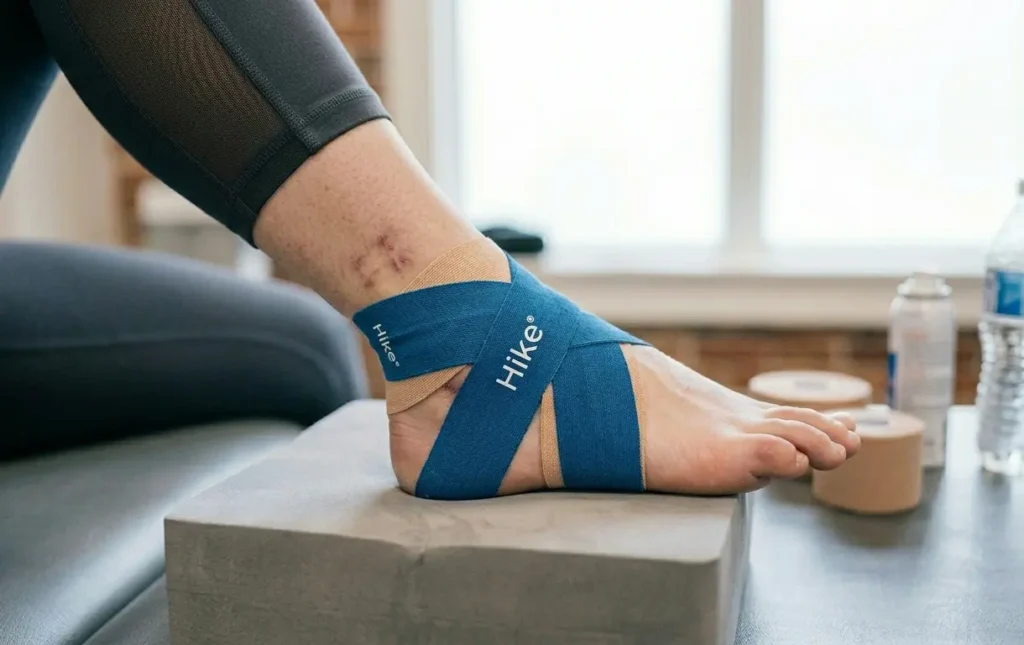
- Incorporate Bracing Strategic Patterns: Do not rely on a rigid plastic brace for sitting or normal desk work, as this can make your muscles lazy over time. However, you should wear a lace-up ankle brace with lateral stabilizers when participating in recreational sports, long walks, or hiking over uneven terrain. The brace serves as a temporary external guide while your internal muscles are still building their natural strength during your course of Ankle Instability Rehab in Indore.
- Scan Your Walkways Proactively: Train yourself to look three to four steps ahead of you when walking through areas with unpredictable flooring, such as around Ocean Park, Skye Luxuria, or BCM Paradise. Spotting a loose paver, a wet floor tile, or an unpaved patch of grass early gives your nervous system ample time to adjust your posture and gait before your foot meets the hazard.
Finding Long Term Stability in Indore
You do not have to live your life constantly looking down at your feet or dreading the next painful twist. Your body has an incredible capacity to adapt and strengthen, provided you feed it the correct physical stimulus. Chronic instability is not an unchangeable sentence; it is a sign of an incomplete recovery from an old injury that can be fully corrected through medical Ankle Instability Rehab in Indore.
By shifting your focus from passive resting to an active, science-driven physical therapy routine, you can rebuild the deep mechanical support your lower leg desperately needs. Whether your long term goal is to return to competitive sports, go for worry-free evening jogs around Divine Greens, Shekhar Paradise, or Balaji Skyz, or simply walk through your office at Atlanta Aura with complete confidence, a dedicated program for Ankle Instability Rehab in Indore is your path toward a stable, active, and pain-free life.
To safely navigate your recovery path and explore specialized ligament programs, check out the resources listed on our Complete Guide to Ankle Sprain blog. If you have experienced an acute ankle injury and need information on how physiotherapy can be useful in treating that, you can refer to our Ankle Sprain First Aid Guide.
Frequently Asked Questions About Chronic Ankle Instability
1. Why does my ankle keep twisting even when I am just walking on a flat floor?
When you experience multiple sprains, the ligaments on the outside of your ankle become physically stretched and loose. More importantly, the tiny nerve endings inside those ligaments that tell your brain where your foot is located are damaged. Because of this poor communication, your brain cannot send the signal for your muscles to brace your foot quickly enough, causing you to trip over perfectly flat surfaces. It can be easily managed by following through an Ankle Instability Rehab in Indore.
2. How can I distinguish between a standard sprain and chronic ankle instability?
A standard sprain is an isolated, acute injury accompanied by significant swelling, bruising, and immediate pain that gradually resolves over a few weeks. Chronic instability is a long term condition that remains long after the initial swelling is gone. It is marked by a persistent feeling of looseness, a constant fear that your foot will roll, and repeated twisting episodes during everyday activities.
3. Can an old, neglected ankle injury cause knee or hip pain later in life?
Yes, it absolutely can. If your ankle is stiff or structurally unstable, your body will instinctively change the way you walk to minimize weight on that side. This altered walking pattern forces your knee, hip, and even your lower back to absorb abnormal mechanical forces, frequently resulting in secondary overuse injuries and joint pain in those areas over time.
4. How long does a standard program for Ankle Instability Rehab in Indore take to show results?
Most patients begin to notice a measurable improvement in their everyday balance and overall joint confidence within four to six weeks of Ankle Instability Rehab in Indore. However, completely reshaping weak scar tissue and building reliable muscle memory in the peroneal groups typically requires eight to twelve weeks of consistent, progressive training.
5. Is it safe to wear a supportive ankle brace every single day?
Wearing a brace during high risk activities, like sports or walking on uneven ground, is highly recommended to protect your joint. However, wearing a brace all day long during resting or light office work can make your ankle lazy, as the brace takes over the work your muscles should be doing. It is best to use the brace strategically while actively working to strengthen your muscles through exercise.
6. What are the best exercises to stabilize an ankle that keeps rolling?
The most effective movements focus on strengthening the peroneal muscles on the outside of your shin and improving your overall balance. Excellent options include resisted band eversion exercises, single leg balance holds on flat ground, and advanced proprioceptive training using balance discs or unstable foam cushions. These are included in our Ankle Instability Rehab in Indore program.
7. Will an ATFL ligament tear heal on its own without requiring surgery?
The vast majority of partial ATFL tears heal successfully without surgery through proper physical therapy. While the ligament tissue itself may remain slightly elongated, you can completely compensate for this looseness by building exceptional strength and speed in the surrounding muscle groups to keep the joint stable.
8. When should I stop physical therapy and consider consulting an orthopedic surgeon?
If you have dedicated yourself to a structured Ankle Instability Rehab in Indore for three to four months and still experience regular episodes of your ankle giving out during low impact daily activities, it is time to consult a specialist. This continuous instability suggests a complete ligament rupture that may require mechanical surgical repair.
9. Can doing calf raises help prevent my ankle from rolling inward?
Calf raises are excellent for strengthening the gastrocnemius and soleus muscles, which provide power and support to the back of your foot. While they are a vital part of general lower leg health, you must pair them with eversion exercises using a resistance band to specifically protect the ankle from rolling inward.
10. Is running safe if I currently have weak and unstable ankles?
Running on unpredictable outdoor surfaces or trails is highly risky when your joints are unstable and can lead to severe re-injury. You should pause outdoor running until you have rebuilt baseline stability through focused rehabilitation. In the meantime, stick to safer, low impact options like stationary cycling or swimming to maintain your cardiovascular fitness.
Medical Disclaimer: The information provided inside this article is intended strictly for educational and informational purposes. It should not be used as a replacement for professional medical diagnosis, advice, or a tailored treatment plan. Always consult with a qualified healthcare professional or an orthopedic specialist before starting any new exercise or rehabilitation program, especially if you suffer from severe joint pain, structural instability, or a suspected ligament tear.