
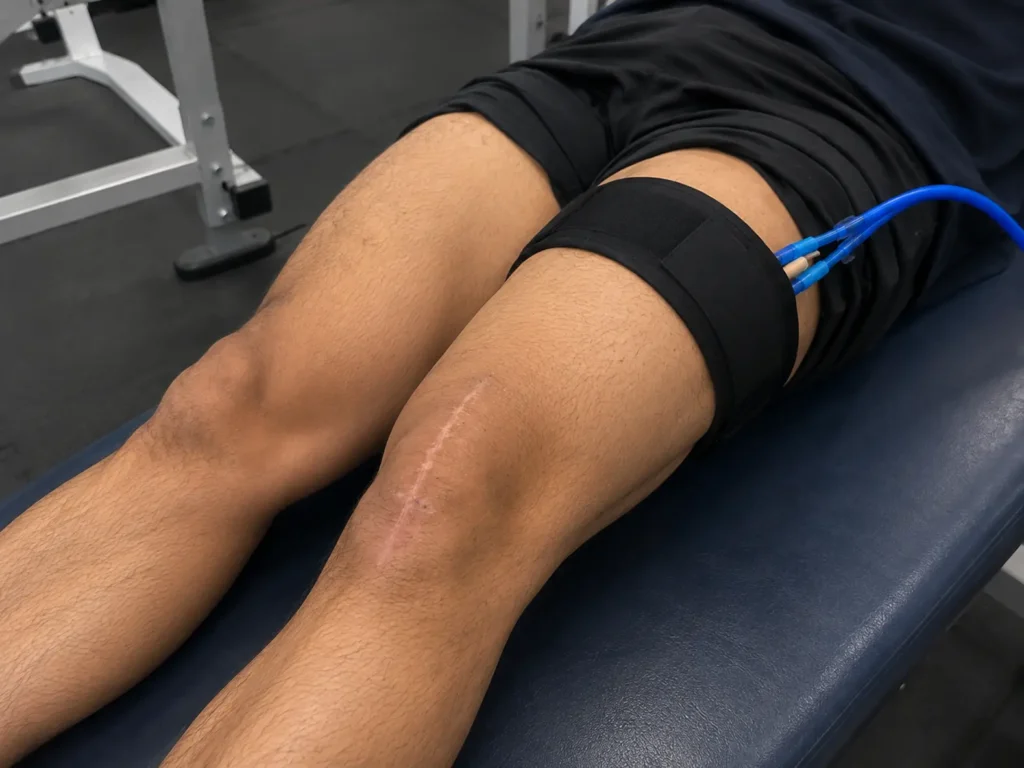
A few weeks after ACL surgery, most patients hit the same frustrating wall. Your knee is healing, but your thigh muscle, especially the quadriceps, has visibly shrunk and feels noticeably weaker. The problem is that lifting heavy weights to rebuild that strength is exactly what your knee is not ready for yet. This is precisely the gap that BFR training after ACL surgery in Indore is designed to fill.
Blood flow restriction training, usually shortened to BFR training, allows you to build meaningful strength using very light loads, which means you can start challenging your muscles again long before your knee could safely handle heavy weights. It has become one of the more advanced tools used in post-surgical rehabilitation, and it is particularly well studied in ACL recovery specifically but research has also shown benefits for conditions such as knee osteoarthritis, other post-surgical knee and shoulder rehabilitation and tendinitis.
This guide explains what BFR training is, why it works so well after ACL surgery, what a session actually involves, and what to know about its safety before starting.
What Is BFR Training?
According to the Cleveland Clinic, blood flow restriction training uses a specialized cuff or band around the thigh or arm to reduce blood flow out of the area while you exercise, allowing you to gain strength while training at a much lower intensity than usual. The cuff is inflated to a carefully calculated pressure, high enough to restrict how quickly blood leaves the muscle, but not so high that it cuts off the blood supply coming in.
This creates a metabolic environment inside the muscle that closely resembles what happens during heavy, high-load training, even though you are only lifting a fraction of the weight. For a knee that has just been through ACL reconstruction and cannot yet tolerate heavy loading, this makes BFR training after ACL surgery in Indore a genuinely useful option rather than just a passing fitness trend.
Why BFR Training Is Especially Useful After ACL Surgery
ACL reconstruction almost always leads to some degree of quadriceps muscle atrophy, both from the surgery itself and from the reduced activity that follows. Rebuilding this muscle quickly and safely is one of the most important parts of ACL rehabilitation, since strong quadriceps are closely linked to a stable, well-functioning knee and a lower risk of reinjury.
The challenge is that early after surgery, the knee simply cannot handle the heavy resistance training normally used to build muscle. This is exactly where BFR training after ACL surgery in Indore becomes valuable. Research reviewing patients before and after ACL reconstruction found that BFR training applied after surgery was associated with improvements in knee extensor and flexor strength, along with increases in quadriceps muscle size, when compared to standard rehabilitation without BFR (source).
In practical terms, this means patients can begin meaningful strength training earlier in their recovery timeline, rather than waiting until the knee can tolerate heavier loads, potentially shortening the overall path back to full function.
How a BFR Training Session Works
A typical BFR training after ACL surgery session generally follows a structured process:
- Cuff placement, positioning a specialized pneumatic cuff around the upper thigh of the operated leg
- Pressure calibration, setting the cuff to a specific percentage of your individual limb occlusion pressure, rather than a generic fixed number, to keep the technique both safe and effective
- Low-load exercise, typically using twenty to forty percent of what you could normally lift for a single repetition, performed for higher repetitions than standard strength training
- Structured rest intervals, with short breaks between sets while the cuff often remains inflated
- Cuff release, allowing normal blood flow to fully return once the exercise set is complete
Exercises commonly used with BFR training after ACL surgery in Indore include straight leg raises, mini squats, and controlled knee extensions, all chosen specifically because they can be performed safely at low loads while still targeting the quadriceps and surrounding muscles effectively.
Is BFR Training Safe?
When performed correctly and under professional supervision, BFR training has a strong safety record. According to the Cleveland Clinic, most people can perform BFR training safely, though there are certain health conditions where it is not recommended, including blood clotting issues and bone fractures.
This is exactly why BFR training after ACL surgery in Indore should always be performed under the guidance of a trained physiotherapist rather than attempted independently at home with generic bands. A qualified physiotherapist will take a full health history, screen for contraindications, and calculate the correct cuff pressure for your specific limb, rather than applying a one-size-fits-all approach.
Some conditions that generally rule out BFR training include a history of blood clots or deep vein thrombosis, uncontrolled high blood pressure, certain cardiovascular conditions, and pregnancy. This is why a thorough screening always comes before your first session.
When Does BFR Training Start After ACL Surgery?
The right timing depends on your surgeon’s protocol and how your knee is healing, but BFR training after ACL surgery is often introduced earlier in the rehabilitation timeline than traditional heavy resistance training, sometimes within the first few weeks post-surgery, once initial swelling and pain have settled enough to tolerate exercise. This is one of its biggest advantages: it allows meaningful strengthening work to begin well before the knee is ready for conventional heavy loading.
Your physiotherapist will typically introduce it gradually, starting with simpler movements and progressing the exercises as your knee’s healing timeline allows, always working within the limits set by your surgeon’s specific post-operative protocol.
BFR Training Versus Traditional Strength Training After Surgery
It is natural to wonder how BFR training after ACL surgery actually compares to the strength training you would eventually do without it. The core difference comes down to timing and load, not the end goal. Traditional strength training typically requires lifting sixty to seventy percent or more of your maximum capacity to build meaningful muscle strength, a level of loading your knee simply cannot tolerate in the early months after ACL reconstruction.
BFR training sidesteps this problem by using the restricted blood flow environment to trick the muscle into responding as though it were lifting a much heavier load, even though the actual weight on the joint stays light. This is precisely why it has become such a useful bridge in ACL rehabilitation, allowing meaningful strength gains during the window when conventional heavy training is off the table. Once your knee has progressed enough to safely handle higher loads, your physiotherapist will typically transition you toward more traditional strength training, often continuing to use BFR alongside it for certain exercises rather than dropping it immediately.
What Results Can You Expect?
Patients using BFR training after ACL surgery as part of a structured rehabilitation program often notice:
- Reduced muscle atrophy in the early post-surgical period, when heavy loading is not yet possible
- Faster return of visible quadriceps muscle size and definition
- Improved strength scores on standard rehabilitation testing compared to standard protocols alone
- A smoother transition into traditional strength training once the knee is ready for heavier loads
It is worth being realistic here: BFR training is a valuable addition to a well-structured ACL rehabilitation program, not a replacement for the rest of it. Range of motion work, balance training, gait retraining, and eventually sport-specific and return-to-play exercises still remain essential parts of full recovery.
What to Expect at Your First BFR Training Session in Indore
- A review of your surgical history, current healing stage, and any relevant health conditions
- A screening for contraindications, such as clotting disorders or cardiovascular concerns
- Measurement of your limb occlusion pressure to calculate the correct, individualized cuff setting
- A supervised introductory session with simple, low-load exercises to confirm the technique is well tolerated
- Integration of BFR training after ACL surgery in Indore into your broader, personalized rehabilitation plan
Choosing the Right Clinic for BFR Training in Indore
Since BFR training requires specific equipment and proper training to apply safely, it is worth considering a few things when choosing where to pursue BFR training after ACL surgery in Indore:
- Whether the physiotherapist has specific training or certification in BFR application, not just general rehabilitation experience
- Whether the clinic uses proper pressure calibration equipment rather than a generic, one-size-fits-all band
- Whether you receive a thorough health screening before your first session
- Whether BFR is integrated into a complete ACL rehabilitation plan, rather than used as a standalone technique
If you are exploring related recovery options, you can also read more about our ACL rehabilitation programs or learn about our post-surgery rehabilitation services for a complete view of the recovery process.
A Realistic Outlook on BFR Training After ACL Surgery
BFR training after ACL surgery represents one of the more genuinely evidence-backed advances in post-surgical rehabilitation in recent years. It will not replace the fundamentals of good ACL rehab, careful progression, proper technique, and patience, but it can meaningfully speed up the early strength-building phase that so many patients find frustrating. Used correctly, under proper supervision, it gives your quadriceps a head start while your knee continues healing at its own pace.
The hardest part of ACL recovery is often watching your muscle shrink while you wait for your knee to be ready for real strength work. BFR training helps close that gap safely, rather than making you wait it out.
Frequently Asked Questions About BFR Training After ACL Surgery in Indore
1. How soon after ACL surgery can I start BFR training?
This depends on your surgeon’s protocol and your individual healing progress, but it is often introduced earlier than traditional heavy resistance training, sometimes within the first few weeks after surgery.
2. Does BFR training hurt?
Most patients describe a sensation of muscle fatigue and tightness rather than pain. The cuff pressure should feel firm but tolerable, and a properly trained physiotherapist will adjust it if it feels excessive.
3. Can BFR training replace regular ACL physiotherapy exercises?
No. It is a valuable addition to a complete rehabilitation program, not a replacement for range of motion work, balance training, and sport-specific exercises.
4. Is BFR training safe for everyone recovering from ACL surgery?
Not for everyone. Certain conditions, including clotting disorders and some cardiovascular issues, rule it out. A proper health screening before starting is essential.
5. How many BFR training sessions are usually needed?
This varies by individual protocol, but it is often used two to three times a week during the early to mid stages of ACL rehabilitation, alongside other rehab exercises.
6. Can I do BFR training at home with bands I bought online?
This is not recommended, particularly after ACL surgery. Proper cuff calibration and health screening require professional guidance to be both safe and effective.
7. Will BFR training help me return to sport faster after ACL surgery?
It can support faster strength recovery in the early phase, which may contribute to a smoother overall rehabilitation timeline, though return-to-sport timing still depends on many other factors, including your surgeon’s clearance.
8. Does BFR training cause muscle damage?
When performed correctly under professional supervision, BFR training has a good safety profile. Like any resistance training, some muscle fatigue is expected, but it should not cause lasting harm when properly supervised.
9. Is BFR training only useful for the quadriceps after ACL surgery?
It is most commonly used for the quadriceps and hamstrings after ACL surgery, since these muscles are most affected by post-surgical atrophy, though it can be applied to other muscle groups as needed.
10. How is BFR training different from regular light exercise?
The cuff creates a specific metabolic environment in the muscle that mimics the effects of heavy training, which is what allows light-load exercise to produce strength gains that ordinary low-load exercise alone typically cannot achieve.
Medical Disclaimer: This article is intended for general informational purposes only and does not replace professional medical advice, diagnosis, or treatment. BFR training should only be performed under the supervision of a qualified physiotherapist after appropriate health screening. Please consult your surgeon and physiotherapist to determine whether it is appropriate for your specific recovery.