
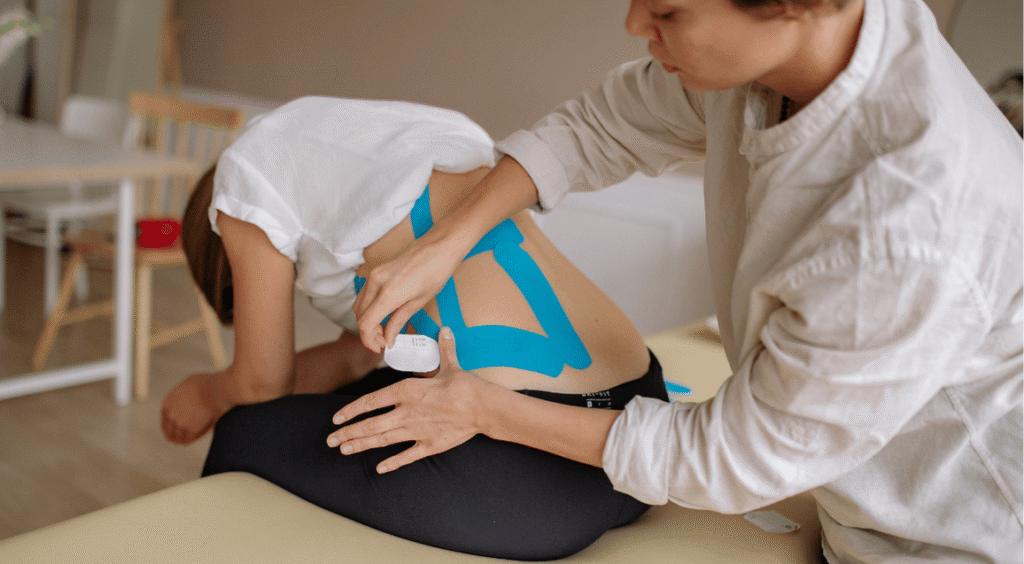
You have probably seen it on cricketers, badminton players, and runners at the Race Course Road track: bright strips of stretchy tape running across a knee, a shoulder, or the back of a calf. Maybe a friend swears it saved their season. Maybe your physiotherapist has suggested it for your own pain, and you are wondering whether it is a genuine treatment or just a colourful placebo. That is exactly the question this guide answers about kinesio taping therapy in Indore.
The honest answer sits somewhere between the hype and the scepticism. Kinesio tape is not magic, and it will not heal a torn ligament. But it is also not nonsense. Used for the right reasons, applied correctly, and combined with active rehabilitation, kinesio taping therapy in Indore can offer real, practical support while your body does the actual healing. Let us look at what it is, how it works, and what the research genuinely says.
What Is Kinesio Taping?
Kinesio tape, also called kinesiology tape or KT tape, is a thin, stretchy cotton strip with an adhesive backing that is applied directly to the skin over a muscle or joint. Unlike traditional rigid sports tape, which locks a joint in place, it is designed to move with your body. According to the Cleveland Clinic, it is thin, stretchy and applied directly over a joint, and because it does not restrict movement the way traditional tape does, athletes can keep wearing it during practice and competition.
The technique was developed in Japan in the 1970s and became widely known after appearing on athletes at international competitions. Today, kinesio taping therapy in Indore is offered by many physiotherapy and sports injury clinics as one part of a broader treatment plan, rather than as a standalone cure.
How Does Kinesio Taping Work?
Here is where honesty matters, because nobody has fully proven the mechanism. Several explanations are proposed, and each probably contributes a little:
- Sensory feedback. The tape sits on your skin and gives your brain constant, gentle information about where that body part is in space. This improves your awareness of joint position, which clinicians call proprioception.
- Gentle mechanical support. A well-applied strip can take a little load off an irritated muscle or tendon, similar to a light rubber band assisting the structure underneath.
- Skin lifting. Some researchers suggest the tape slightly lifts the skin, which may ease pressure on the tissues below and support circulation and fluid movement.
- Confidence and comfort. Feeling supported often changes how freely a person moves, which can reduce guarding and fear of movement during rehabilitation.
That last point is not a dismissal. Reducing fear and tension is a legitimate clinical benefit, and it is one reason patients often report feeling more comfortable exercising with the tape on. Understanding these mixed mechanisms helps you see kinesio taping therapy in Indore for what it is: a helpful support tool, not a mysterious healing force.
What Does the Research Actually Say?
A balanced reading of the evidence is more useful than either a sales pitch or a dismissal. The Cleveland Clinic notes that research suggests kinesio tape may help relieve pain in people with chronic musculoskeletal pain, that one study found it reduced pain in people with osteoarthritis, and that research is mixed on shoulder tendinitis. The same source is clear that there are no proven long-term benefits, and that the tape is not a standalone therapy but can be paired with other treatments.
Larger reviews tell a similar story. Recent analysis suggests the tape may give immediate, short-term pain relief and some improvement in limb function, but the certainty of that evidence is low and the results are inconsistent between studies. Whatever benefit exists is small when compared with the effect of proper exercise.
There is one area where the evidence is a little firmer. The Cleveland Clinic reports that the American College of Rheumatology gives a conditional recommendation for kinesio tape in hand and knee osteoarthritis (source). Research on balance and proprioception is also still developing, with studies finding measurable changes in postural stability when tape is applied to the lower limb (source).
The fair summary is this: kinesio taping therapy in Indore can be a reasonable, low-risk addition to treatment, but it works best as a supporting actor, never the lead.
Conditions Where Kinesio Taping Therapy in Indore Is Commonly Used
Physiotherapists tend to reach for the tape in situations like these:
- Knee osteoarthritis and patellofemoral pain, where gentle support and improved awareness can ease activity-related pain
- Shoulder pain and rotator cuff irritation, to support posture and reduce strain during overhead movement
- Ankle sprains and instability, as light support during the return to walking and sport
- Achilles tendon and plantar fascia complaints, to offload irritated tissue during activity
- Postural neck and upper back pain, as a reminder cue to keep the shoulders from rounding forward
- Muscle strains and overuse injuries, to support the muscle while active rehabilitation progresses
- Hand and thumb base osteoarthritis, where the stretchy support allows movement while easing joint stress
What Happens During a Taping Session
- Assessment first. Your physiotherapist examines the painful area and confirms that taping suits your condition and goals.
- Skin preparation. The area is cleaned and dried. Excess hair may be trimmed so the adhesive sits well and comes off comfortably later.
- Measuring and cutting. Strips are cut to size and the corners are rounded, which stops the edges from peeling and catching on clothing.
- Application. The tape is laid down with little or no stretch at the ends and slight tension through the middle, following the direction of the muscle or the joint being supported.
- Activation. The strip is rubbed firmly so body heat activates the adhesive, then you are asked to move the area to check comfort and function.
Done properly, the process takes ten to fifteen minutes. The tape typically stays on for three to five days, and it is designed to survive showers.
Why Technique Matters More Than the Tape Itself
Many patients buy a roll online and apply it themselves after watching a video. This sometimes works for simple situations, but it is worth understanding why professional application is different. Direction of pull, amount of tension, and the choice of anchor points all change the effect. A strip stretched too hard can irritate the skin or tug on the tissue it was meant to relax. A strip placed over the wrong muscle does nothing useful. Choosing a clinic that offers kinesio taping therapy in Indore as part of a proper assessment, rather than as a quick cosmetic add-on, makes a real difference to the outcome.
Who Should Avoid Kinesio Tape?
Kinesio taping therapy in Indore is generally safe and well tolerated, but it is not for everyone. Skip it, or speak to your physiotherapist and doctor first, if you have:
- Open wounds, fresh scars, or skin infections in the area
- A known allergy to adhesives or acrylic, since the glue is the most common cause of reactions
- Fragile, very thin, or damaged skin
- A suspected or known blood clot, such as deep vein thrombosis
- Poor circulation, reduced sensation, or poorly controlled diabetes in the area
- Active cancer in or near the treatment site
Before any session of kinesio taping therapy in Indore, a good clinician will ask about allergies and skin conditions, and may do a small patch test first.
Looking After Your Tape and Your Skin
Indore summers are hot and humid, which makes skin care especially important for anyone receiving kinesio taping therapy in Indore during the warmer months, since sweat can weaken the adhesive and irritate sensitive skin. Pat the tape dry after showering rather than rubbing it. Never pull it off quickly. Instead, soak it with a little oil or warm water, then peel it slowly in the direction of hair growth while holding the skin down. Remove it immediately if you notice intense itching, blistering, numbness, a tingling sensation, or the tape feeling uncomfortably tight, and tell your physiotherapist.
Questions Worth Asking Before You Start
- Why is taping recommended for my particular condition?
- What active exercises will I be doing alongside the tape?
- How long will I need it, and how will we know if it is helping?
- Is there anything about my skin or health history that makes taping unsuitable?
A physiotherapist offering kinesio taping therapy in Indore should welcome these questions. If the answer is simply that it will fix everything, treat that as a warning sign.
If you would like to know more about the treatments it commonly supports, you can read about our sports injury rehabilitation services or explore our dry needling therapy services to see how taping fits into a complete recovery plan.
A Realistic Outlook
Kinesio tape will not rebuild a damaged joint, speed up healing by itself, or replace the hard work of strengthening and movement retraining. What it can do is offer comfortable, flexible support, sharpen your body awareness, and give you the confidence to keep moving while you recover. Used thoughtfully, kinesio taping therapy in Indore is a pleasant, low-risk helper, and its greatest value shows up when it sits alongside a well-designed exercise programme.
The tape is the assistant, not the treatment. Your recovery still depends on movement, strength, and a plan built around your body.
Frequently Asked Questions About Kinesio Taping Therapy in Indore
1. Does kinesio taping really work?
It can give short-term pain relief and a feeling of support for some conditions, particularly osteoarthritis and certain tendon and joint complaints. The evidence is mixed, and the effects are modest compared with exercise.
2. How long can I keep kinesio tape on?
Most strips can stay on for three to five days. Remove it earlier if you develop itching, redness, blistering, or discomfort.
3. Can I shower or swim with it on?
Yes, most tapes are water resistant, so showers are fine. Pat the tape dry afterwards rather than rubbing it, since friction loosens the edges.
4. Does kinesio taping hurt?
No. Applying it should feel like nothing more than light pressure. Removal can pull slightly on the skin if done quickly, which is why slow, gentle removal is recommended.
5. Is kinesio tape the same as normal sports tape?
No. Traditional rigid tape limits movement to protect a joint, while kinesio tape is stretchy and lets you keep moving freely.
6. Can I tape myself at home?
For very simple cases you can, but technique matters. Direction, tension, and placement all change the effect, so it is best to have your physiotherapist apply it and show you what to expect first.
7. Will kinesio tape help my lower back pain?
Reviews have not found that taping meaningfully reduces low back pain on its own, so it is not usually the first choice. Exercise and movement retraining are better supported.
8. Can children and older adults use kinesio tape?
Often yes, but skin is more fragile at both extremes of age, so extra care with adhesive choice and removal is important.
9. Does kinesio tape improve sports performance?
Studies have generally not shown reliable improvements in jumping, running, or overall athletic performance. Its main role is comfort and support during activity.
10. Is kinesio taping therapy in Indore suitable alongside other treatment?
Yes, that is exactly how it works best. It is commonly combined with exercise, manual therapy, and other active rehabilitation rather than used alone.
Medical Disclaimer: This article is intended for general informational purposes only and does not replace professional medical advice, diagnosis, or treatment. Please consult a qualified physiotherapist or doctor to find out whether kinesio taping is appropriate for your specific condition.